
Transfer Pricing Explained for Beginners
Transfer pricing can seem like an esoteric concept, but it is crucially important for multinational companies. In simple terms, what is transfer pricing refers to the prices charged for goods, services, or intellectual property between related parties or divisions within a multinational enterprise. It plays a crucial role in how profits are allocated across different jurisdictions and, consequently, how much tax a company pays transfer pricing in income tax and where it pays it.
Key Principles of Transfer Pricing Rules
Arm’s Length Principle in Transfer Pricing
At the heart of transfer pricing is the arm’s length principle. This principle stipulates that the amount charged by one part of a company to another for a given product or service should be the same as if the entities were not related (i.e., they are transacting at arm’s length).
In this way, transfer pricing aims to prevent companies from manipulating their internal prices to minimize their overall tax liabilities.
Who Are Related Parties in Transfer Pricing?
Understanding objectives of transfer pricing applicability requires an understanding of the concept of related parties or “associated enterprises”. These are entities that have a certain degree of common ownership or control – enough to potentially influence the terms of their commercial or financial relationships.
Transfer Pricing Methods Used Globally
To implement the arm’s length principle, a variety of transfer pricing methods’ are employed:
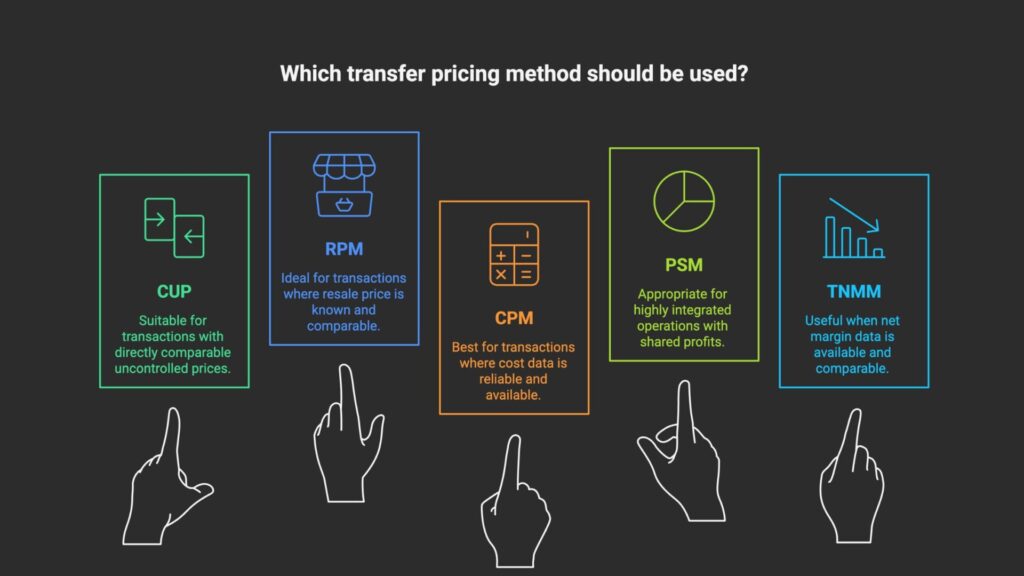
- Transactional Net Margin Method (TNMM): The net profit margin is compared to that which the same enterprise realizes from transactions with independent enterprises.
- Comparable Uncontrolled Price (CUP) Method: This involves comparing the price charged for goods or services in a controlled transaction to the price charged in a comparable uncontrolled transaction.
Resale Price Method (RPM): RPM begins with the price at which a product that has been purchased from an associated enterprise is resold to an independent enterprise. - Cost Plus Method: This considers the cost of production and adds a mark-up that unrelated parties would consider acceptable.
- Profit Split Method: This method determines the division of profits that independent enterprises would have expected to realize.
OECD Transfer Pricing Guidelines and Local Laws
Internationally, transfer pricing is guided by a number of frameworks, most notably the OECD transfer pricing guidelines. These guidelines provide valuable insights and standards on the application of the arm’s length principle.`
In addition to the OECD guidelines, other countries may have their own specific rules and regulations related to international taxation. For example, the United States’ Internal Revenue Service (IRS) and India’s Central Board of Direct Taxes (CBDT) have established their own detailed guidelines. Businesses must stay updated with these regulations to ensure tax compliance and minimize the risk of audits and penalties.
Transfer Pricing Risks and Common Challenges
Tax Disputes and Audit Risks
The most substantial risk associated with transfer pricing audit is the potential for tax disputes. Differences in tax regulations and rates across countries can lead to disagreements about how much tax should be paid and where. This could result in audit risk and potentially hefty penalties if companies can’t substantiate their transfer pricing documentation.
Transfer Pricing Comparability Issues
Setting transfer prices can also be complex due to the need for comparability analysis. Finding comparable transactions between unrelated parties, which serve as a benchmark for arm’s length price, can be difficult and time-consuming.
Double Taxation in Transfer Pricing
Another challenge is the risk of double taxation. This happens when two countries disagree on the transfer price for a transaction and the multinational enterprise ends up being taxed twice on the same income. The related issue of economic double taxation occurs when different entities within the same company are taxed separately by different jurisdictions on the same income.
Best Practices for Transfer Pricing Compliance
How to Create a Transfer Pricing Policy
Given the challenges and risks associated with transfer pricing, it’s crucial for businesses to develop robust strategies:Transfer pricing policy: Companies should have a clear policy that defines their approach to setting transfer prices, including the methodologies used and the rationale behind them. This policy should be regularly reviewed and updated to reflect changes in business operations or transfer pricing income tax laws.
Need help creating a pricing policy? Book a Consultation
Transfer Pricing Documentation Requirements
Keeping comprehensive transfer pricing documentation is key for proving that transfer prices are set at arm’s length. Documentation should include details of transactions, the methods used to set prices, and any comparability analysis carried out.
Avoiding Disputes With Advance Pricing Agreements (APAs)
Engaging in proactive dialogue with tax authorities and making use of mechanisms such as Advance Pricing Agreements (APAs) can help prevent transfer pricing risk. If disputes do arise, businesses should be prepared with a strong defense strategy, backed up by solid documentation.
Transfer Pricing Case Studies of Major Companies
Apple Transfer Pricing Case (EU, 2020)
Case studies offer a practical perspective on transfer pricing. Consider, for instance, the case of Apple Inc. In 2020, the multinational enterprise won a major legal victory when the General Court of the European Union overturned a previous decision by the European Commission. The Commission had ordered Apple to pay Ireland €13 billion in back taxes, alleging that the company had received illegal state aid via favorable transfer pricing arrangements. However, the Court found that the Commission failed to prove this beyond a reasonable doubt, illustrating the complexities and uncertainties in this area.
Amazon vs IRS: IP Pricing Dispute
In 2017, Amazon won a significant legal battle against the IRS over a dispute that started in 2005. At issue was the price that Amazon’s U.S. parent company had charged a European subsidiary for intellectual property rights. The U.S. Tax Court ruled in favor of Amazon, stating that the IRS had overestimated the value of the intangibles. The case underlines the importance of having a robust method for pricing intangibles in intra-group transactions.
Coca-Cola IRS Case on Brand Royalty
A long-running dispute between Coca-Cola and the IRS reached a pivotal moment in 2020 when the U.S. Tax Court largely upheld the IRS’s determination that Coca-Cola had undercharged seven foreign affiliates for the use of its brand and formula. The case revolved around whether Coca-Cola had appropriately followed a 1996 agreement with the IRS in subsequent years. The decision may result in Coca-Cola owing over $3 billion in taxes and penalties, demonstrating the high stakes involved in transfer pricing and transfer pricing audit.
GSK Settlement with IRS
In 2006, the pharmaceutical giant agreed to pay $3.4 billion to settle its transfer pricing dispute with the IRS. The dispute was primarily over the price at which GSK’s U.S. subsidiary bought drugs from its U.K. parent for resale in the U.S. This case is notable as it resulted in the largest settlement in a transfer pricing income tax matter.
Vodafone India Transfer Pricing Case
One of the most notable transfer pricing cases in India involves Vodafone. The crux of the dispute was the issuance of shares by Vodafone India to its Mauritius-based parent company. The CBDT argued that the shares were undervalued and hence an income had arisen that was subject to transfer pricing applicability. However, in 2014, the Bombay High Court ruled in favor of Vodafone, stating that issuance of shares is a capital account transaction and does not give rise to income, and thus falls outside the scope of transfer pricing regulations.
Shell India Case on Share Valuation
Similar to the Vodafone case, Shell India was also involved in a transfer pricing dispute with the Indian tax authorities over the issuance of shares. Shell India issued shares to its overseas parent company, and the authorities alleged undervaluation. However, the Bombay High Court ruled in favor of Shell in 2014, reiterating that under-pricing of shares cannot be deemed as income and does not fall within the purview of transfer pricing rules.
Maruti Suzuki AMP Expenses Case
In a significant ruling in 2018, the Delhi High Court held that advertising, marketing, and promotion expenses (AMP expenses) incurred by Maruti Suzuki India Ltd. did not constitute an international transaction, and thus no transfer pricing adjustment was warranted. This was a significant decision, as it clarified the position on AMP expenses under India’s transfer pricing rules.
Trends Shaping the Future of Transfer Pricing
Digital Economy and Transfer Pricing
One major trend is the increasing scrutiny of digital transactions and TP as governments explore how to tax businesses that derive value from the digital economy and tax without physical presence in a country.
COVID-19 Impact on Transfer Pricing
The COVID-19 impact on transfer pricing has also triggered changes in business structures and supply chains, creating a need to reassess comparability analysis and pricing benchmarks.
Global Tax Policy and Transfer Pricing Reform
Global tax policy developments and transfer pricing reform efforts are expected to evolve in response to globalization and changing economic dynamics.
Final Thoughts on Managing Transfer Pricing
Transfer pricing is a complex but critical aspect of international taxation for multinational enterprises. By understanding its principles, staying informed about international guidelines, and implementing effective strategies, businesses can navigate transfer pricing challenges and minimize their tax risk.
Need clarity on transfer pricing?
Resources to Learn More About Transfer Pricing
For those interested in delving deeper into the world of transfer pricing, resources such as the OECD Transfer Pricing Guidelines, local tax authority guidelines, and professional tax consulting services can provide further guidance.
FAQs: Transfer Pricing Explained Simply
1. What is transfer pricing in simple words?
Transfer pricing is how companies set prices when they buy or sell between their own branches in different countries. It’s a way to track how money moves inside the company.
2. Why do companies use transfer pricing?
Companies use transfer pricing to figure out profits between different parts of the business. It helps with taxes, cost control, and staying legal with cross-border rules.
3. What is an example of a transfer pricing case?
A big one is the Apple case in Europe. The EU said Apple owed €13 billion in back taxes. But Apple won the case in 2020. It shows how tricky transfer pricing laws can be.
4. Is transfer pricing legal in India?
Yes, it’s legal. But companies have to follow Indian tax laws and OECD transfer pricing guidelines. If not, they can get audited or fined.
5. What are the methods used in transfer pricing?
The main ones are:
- Comparable Uncontrolled Price (CUP)
- Cost-Plus Method
- Resale Price Method
- Profit Split
- TNMM (Transactional Net Margin Method)
These help decide fair prices within a group.
6. Why do tax departments check transfer pricing?
To stop tax avoidance. If a company shifts profit to a country with low taxes, the local tax office may lose revenue. So they audit big companies to make sure everything’s priced fairly.